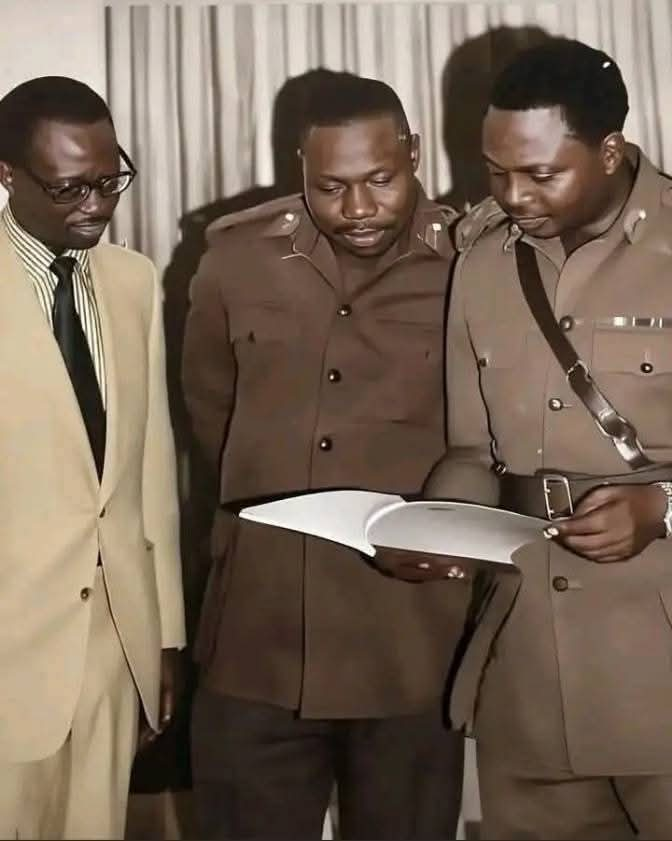
I read with consternation on Baba Ayoade Ojeniyi wall a piece credited to Tim Fijabi, which troubled me. It was directed at today’s youths, painting them as mere errand boys, as directionless lots with no future ambition, no compass of destiny. The piece, couched in sweeping generalisation, compared us with the supposed gallantry of Nigeria’s founding leaders, noting that Obasanjo became Chief of Staff, Supreme Headquarters at 37, Murtala Mohammed became Head of State at 36, Gowon was 31 when he assumed power, and that young men like Adamu Ciroma were sitting at the apex of national institutions before they even crossed their fortieth birthdays. To further ruminate on this, my thoughts point to the likes of Thomas Sankara, who became President of Burkina Faso at 33, Kwame Nkrumah leading Ghana in his early forties, and Mandela, whose fire of youth lit the African National Congress.
The question the writer seemed to be asking, in my view, was: where are the youths of today? Why are they not at the commanding heights of leadership, of governance, of national transformation? Why have they become no more than errand boys to the same politicians who, in their youth, were kings of their own destiny?
It is here I beg to differ. Not in arrogance, but in conscience. We cannot, and must not, blame the youths. The fault is not in them but in the system that has caged them, suffocated them, and reduced them to errand boys in a land where their forefathers had once ruled as lions.
History is stubborn. It resists being bent into falsehood. In Nigeria’s first three decades after independence, leadership was a terrain conquered by the young. Tafawa Balewa was only 48 when he became Prime Minister. Nnamdi Azikiwe was 55 when he became ceremonial President, but long before then, in his thirties, he had already set up newspapers that rattled the colonial order. Obafemi Awolowo was 44 when he became Premier of the Western Region, but his great work, Path to Nigerian Freedom, was written when he was still a young lawyer in his thirties.
Across the continent, it was the same. Nkrumah was barely 41 when Ghana gained freedom in 1957. Patrice Lumumba, in his thirties, stood in the face of Belgian royalty to denounce colonialism with a tongue that remains unmatched. Thomas Sankara was only 33 when he became President, and in four brief years, he redefined the meaning of leadership in Africa. He sold the presidential fleet, banned luxury for officials, empowered women, planted millions of trees, and lived simply, riding bicycles through Ouagadougou. His youth was not a liability. It was his strength.
These men were not perfect, but they were enabled by their time. They lived in a system that had vacancies at the top for the ambitious. The colonialists had packed and gone, leaving offices to be filled. Universities were few but functional, scholarships were abundant, and jobs awaited graduates like grooms awaiting brides. They rose through ladders already placed before them.
Contrast that with today. What ladders remain? The youth of this generation are more educated than their predecessors. They are more technologically sophisticated, more globally exposed, more civil, and yes, more morally upright than many who ruled before them. But they are caged.
When a graduate finishes youth service today, he faces not the waiting hand of employment but the abyss of joblessness. In the 1970s, university graduates had job letters dispatched before graduation. Today, thousands of graduates chase after one clerical job, while others “japa” to Europe and America, not out of betrayal of their fatherland, but out of desperation to breathe.
The leaders of old never had to contend with ASUU strikes that spanned eight months, never had to write JAMB five times, and never had to pay millions to private universities because public ones were in ruins. They had jobs waiting. Today’s youth, after spending fortunes on education, are told to “become entrepreneurs” in an economy where power is epileptic, roads are impassable, and policies change with the mood of the man in Aso Rock.
It is not that youths of today lack ambition. It is that ambition that is starved. Like a flame in a jar, it is burning but suffocated.
I refuse to agree that the youths are lazy or wayward. What I see is that the vineyard has been wasted by elders who ate sour grapes. They keep the youths as errand boys, not because youths cannot lead, but because the system is rigged to prevent their flowering.
Look around: youths are used to thumping ballots, to chanting at rallies, to flooding social media with hashtags. They are given peanuts, motorcycles, and sometimes sachets of rice. Their intelligence is reduced to loyalty tests, their energy wasted on errands. And yet, these same youths are the ones creating tech start-ups in Yaba, building apps that attract global investors, winning scholarships abroad, excelling in music, film, fashion, and literature. The Nigerian youth is not an errand boy. The Nigerian system is a wicked master.
Chinua Achebe in The Trouble with Nigeria said bluntly: “The trouble with Nigeria is simply and squarely a failure of leadership.” He did not blame the youth. He blamed the system. Walter Rodney, in How Europe Underdeveloped Africa, showed us how colonialism laid the foundation of poverty. But what Rodney perhaps could not have foreseen was how post-colonial leaders would so quickly inherit and perfect the tools of oppression.
Today, Nigerian leaders boast of statistics. They say inflation is falling, the GDP is rising, and the economy has turned a corner. But ask the woman in Gbagi market. Ask the bus driver who cannot afford fuel. Ask the graduate hawking recharge cards. They will tell you no corner has been turned. The only corner is the one into which their lives have been squeezed.
Let us be fair. Compare the twenty-year-old of 1960 to the twenty-year-old of 2025. The former had access to free education in many regions, could afford housing, could marry early, and could aspire to positions in civil service. The latter, though more knowledgeable, is strangled by unemployment, insecurity, and systemic rot.
The earlier generation entered leadership not because they were inherently superior but because the gates were open. Today, those gates are locked, bolted, and guarded by the very elders who once entered freely. They are unwilling to leave, unwilling to share, unwilling even to acknowledge that the youth have wings.
This is why the youth “japa.” They are not betraying Nigeria. Nigeria betrayed them first.
The software engineer in Lagos who spends sleepless nights coding is no errand boy. The medical graduate in Ibadan who saves lives on internship stipends is no errand boy. The young protester who faces teargas in the fight for justice is no errand boy. The young writer who chronicles our collective decay, hoping for rebirth, is no errand boy.
They are lions caged in a zoo built by selfish elders. Give them the same open savannah their forefathers had, and you will see them roar.
Therefore, when elders dismiss youths as errand boys, it is not history they are citing but hypocrisy. It is not truth but self-protection.
We are not asking for favours. We are demanding fairness. Give us the same platform you had, and see if we will not thrive. Give us jobs that match our education, opportunities that reward our sweat, and governance that listens to our voices. Stop using us as foot soldiers. Stop locking us out while you grow fat on our future.
The Yoruba say: Bi omode ba subu, a wo iwaju; bi agbalagba ba subu, a wo eyin. When a child falls, he looks forward; when an elder falls, he looks backwards. The youths are looking forward, seeking hope, seeking change. But the elders, who should be guides, are stuck looking bacbackwardsoarding power, blaming the young for their own failures.
The truth is simple: the youths of today are not directionless. They are direction-blocked. And until the locks are broken, Nigeria will remain a wasted vineyard.
Give us the same ladder you climbed. Then watch us build the Nigeria you failed to build.